
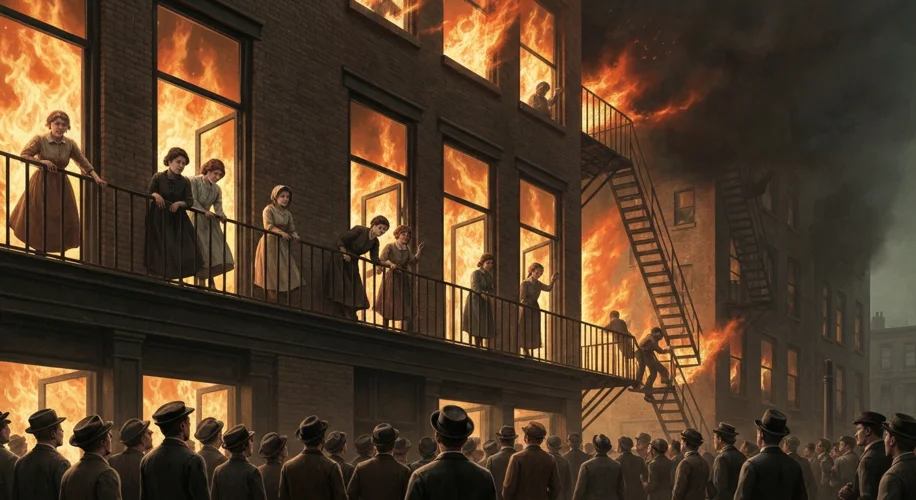
The air in New York City on March 25, 1911, was crisp with the promise of spring, but for the hundreds of young immigrant women toiling away in the Triangle Shirtwaist Factory, it held the suffocating scent of trapped despair. As the afternoon sun cast long shadows across the city, a fire, ignited by a discarded cigarette or a spark from machinery, began its deadly crawl through the eighth, ninth, and tenth floors of the Asch Building. This was not merely a fire; it was a tragedy waiting to happen, a stark testament to the perilous realities of industrial America.
The Triangle Shirtwaist Factory was a titan of the garment industry, producing fashionable “shirtwaists” – the blouses that defined women’s wear in the early 20th century. Its owners, Max Blanck and Isaac Harris, had built a name for themselves, churning out over 15,000 shirtwaists a week. But beneath the veneer of prosperity lay a grim reality. The factory floors were a labyrinth of flammable materials – piles of cotton scraps, oil-soaked machinery, and flimsy fabric bolts. The narrow stairwells were choked with debris, and the fire escapes, often rusted and poorly maintained, offered little hope.
Crucially, the management had taken measures to prevent theft, locking the doors to the stairwells and exits during working hours. The infamous “lock-out” policy, ostensibly to deter workers from taking breaks or stealing fabric, would prove to be a death sentence for many.
Into this inferno stepped a workforce composed overwhelmingly of young Jewish and Italian immigrant women, many barely in their teens. They had left behind poverty and persecution in their homelands, seeking a better life in America. Their dreams were woven into the threads they stitched, their futures dependent on the meager wages earned in these overcrowded, dangerous workshops. Their voices, often unheard in the cacophony of the factory floor and the indifference of factory owners, would soon cry out in a way the nation could no longer ignore.
The fire, which began around 4:40 PM, spread with terrifying speed. Panic erupted. Workers, alerted to the flames, surged towards the exits. But their escape was brutally thwarted. The main stairwell door was jammed, and the fire escape buckled and collapsed under the weight of desperate bodies. In a horrifying spectacle, many women, trapped on the upper floors with flames licking at their heels, were forced to make an impossible choice: burn or leap to their deaths. Onlookers below could only watch in horror as dozens of young women plunged from the windows, their bodies striking the pavement with sickening thuds.
Firefighters arrived, their ladders too short to reach the inferno. Their nets, designed to catch falling bodies, proved useless against the force of the falls. The sheer scale of the tragedy began to unfold with each passing minute. By the time the last embers died out, 146 souls had been lost – 123 women and 23 men. Most of the victims were between the ages of 16 and 23.
The aftermath was a collective shockwave that rippled through New York and the nation. Grief, outrage, and a searing sense of injustice fueled public discourse. The images of the burned bodies, the stories of young women choosing death over the flames, were too potent to be dismissed. The trial of Blanck and Harris for manslaughter ended in acquittal, a verdict that further ignited the flames of public anger. Yet, the tragedy was not without its champions.
Prominent figures and labor organizers, such as Frances Perkins (who later became U.S. Secretary of Labor and witnessed the fire firsthand), Clara Lemlich, and Rose Schneiderman, leveraged the disaster into a powerful catalyst for change. The fire became a rallying cry for the burgeoning labor movement. Public outcry and sustained activism led to the establishment of new labor laws and safety regulations.
Within a few short years, New York State enacted groundbreaking legislation, including the “Sullivan-Hoey Fire Prevention Law,” which mandated stricter fire safety standards, better building codes, and more rigorous factory inspections. The tragedy spurred the creation of the Factory Investigating Commission, which spearheaded reforms aimed at improving working conditions, reducing working hours, and ensuring worker protections across various industries.
The Triangle Shirtwaist Factory fire stands as a somber monument in American history. It is a stark reminder of the human cost of unchecked industrial ambition and the vital importance of workers’ rights. The courage of the victims, their resilience in the face of unimaginable horror, and the tireless efforts of labor activists transformed a horrific tragedy into a turning point for workplace safety and the American labor movement. The echoes of that fateful day in 1911 continue to resonate, urging us to never forget the price of progress and the enduring need for vigilance in protecting the dignity and safety of every worker.