
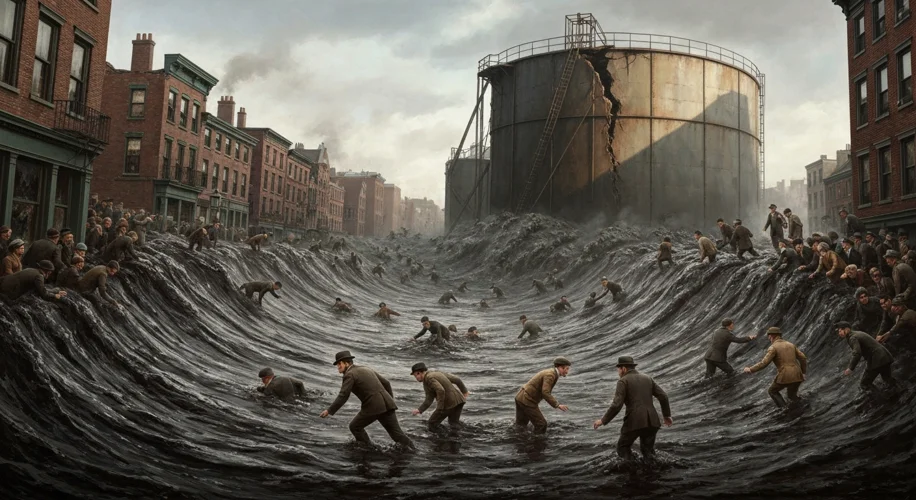
The air in Boston’s North End on January 15, 1919, was unusually mild for January. Children played stickball in the streets, workers hurried home, and the aroma of baking bread mingled with the salty tang of the harbor. It was a day like any other, until it wasn’t. At approximately 12:30 PM, a low rumbling, like distant thunder, began to emanate from the waterfront. It grew rapidly, punctuated by a deafening roar and a violent explosion.
The source of the chaos was a colossal, 50-foot-tall molasses tank owned by the Purity Distilling Company. For years, this behemoth had stood, a towering monument to industrial ambition, holding millions of gallons of molasses destined for the production of rum. But on this fateful day, the tank, hastily constructed and poorly maintained, could no longer contain its sticky burden. It ruptured, unleashing a tidal wave of viscous, brown liquid that surged through the streets with terrifying speed and force.
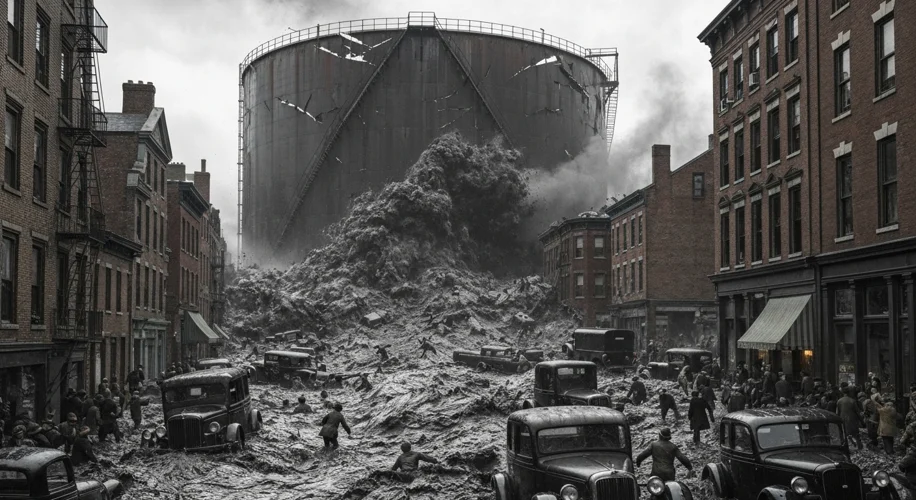
The wave, estimated to be moving at 35 miles per hour and reaching heights of up to 25 feet, was an unstoppable force. It splintered wooden buildings, tore structures from their foundations, and tossed vehicles about like toys. The thick, suffocating molasses trapped anyone unfortunate enough to be caught in its path. Horses were submerged, their desperate whinnies quickly silenced. People, struggling to breathe, were pulled under, their screams drowned out by the viscous flood.
Eyewitness accounts paint a horrific picture of the disaster. One survivor, Frank Hart, described the scene as “a tidal wave of molasses, a sticky, brown horror.” Another, Mary Lehane, recounted how the wave “came like a flood, and went faster than any person could run.” The sheer weight and density of the molasses made escape nearly impossible. It coated everything, hardening as it cooled, creating a suffocating tomb for many.
In the immediate aftermath, a frantic rescue effort began. The sticky substance made it difficult for rescuers to reach victims. Firefighters, police officers, and civilians waded through waist-deep molasses, their efforts hampered by the treacherous goo. The initial death toll was staggering, with 21 people losing their lives, and over 150 injured. The injured suffered from crushing injuries, broken bones, and, most disturbingly, suffocation from the thick molasses that filled their lungs.
The Purity Distilling Company, a subsidiary of United States Industrial Alcohol (USIA), quickly became the focus of blame. Investigations revealed a history of negligence. The tank had been known to leak, with residents often collecting the spilled molasses. Despite these warnings, the company had continued to fill it to capacity. Furthermore, the tank’s construction was found to be substandard, lacking proper reinforcements and testing.
The ensuing legal battle was one of the first major class-action lawsuits in Massachusetts. For years, victims and their families fought for justice and compensation against the powerful USIA. The company initially tried to blame anarchists for bombing the tank, but evidence of structural failure mounted. Ultimately, the court found the company liable, awarding substantial damages to the victims and their families.
The Great Molasses Flood was more than just a tragic accident; it was a stark reminder of the dangers of unchecked industrial ambition and the human cost of corporate negligence. The disaster led to stricter building codes and regulations in Boston and beyond, emphasizing the importance of safety and accountability in industrial practices. The sticky residue of the flood served as a grim, tangible symbol of a community’s resilience in the face of unimaginable disaster, and a powerful lesson etched into the annals of American history.
Even today, some Bostonians claim that on hot summer days, the faint scent of molasses can still be detected lingering in the North End, a ghostly reminder of the day a city was submerged in a sticky, deadly flood.