

Miami. The name itself conjures images of sun-drenched beaches, vibrant nightlife, and a melting pot of cultures. But beneath the glitz and glamour lies a rich and complex political history, a narrative of power struggles, cultural shifts, and enduring transformations. Today, as Eileen Higgins steps into the role of Miami’s first Democratic mayor in three decades, it’s a moment to reflect on the city’s political journey, a path as dynamic and unpredictable as the Atlantic hurricanes that sometimes batter its shores.
Miami’s political landscape hasn’t always been a clear-cut battleground. For much of its modern history, it has been a stronghold of the Republican party, a “Sunshine Republic” as some have called it, reflecting not just its climate but its conservative leanings. This era was shaped by a powerful influx of Cuban exiles following Fidel Castro’s revolution. Many, seeking refuge from communism, found a political home in the GOP, viewing it as the party most aligned with their anti-communist stance and their embrace of free-market principles. Figures like Ileana Ros-Lehtinen, the first Cuban-American woman elected to Congress, became powerful symbols of this shift, representing a significant portion of Miami-Dade’s electorate for decades.
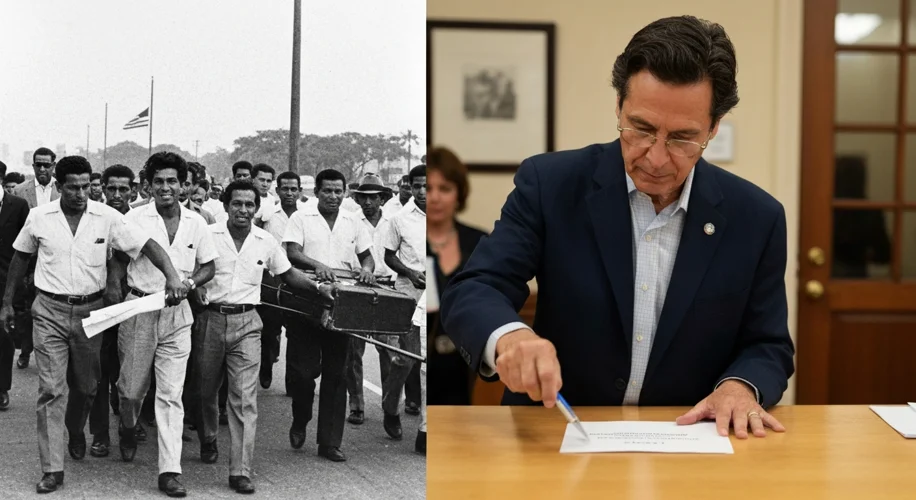
However, Miami’s story is one of constant evolution. The city’s demographics have changed dramatically over the years. A new wave of immigrants from Latin America and the Caribbean, coupled with a growing population of Puerto Ricans, Venezuelans, and other diverse groups, has begun to reshape the political calculus. These communities, while often sharing a desire for economic opportunity, have brought with them a broader spectrum of political beliefs, not always aligning with the traditional Republican platform.
The early 2000s saw the first subtle tremors of this change. While Republicans maintained a strong grip, the Democratic party began to make inroads, particularly in local elections. The sheer diversity of Miami-Dade County, the most populous county in Florida, meant that no single political ideology could hold sway indefinitely. The county’s rapid growth and its position as a gateway to the Americas made it a unique political laboratory, where national trends often played out with a distinct local flavor.
The election of Eileen Higgins as mayor is more than just a party affiliation switch; it signifies a potential turning point in this ongoing narrative. It reflects a growing embrace of Democratic ideals among a segment of the electorate that may have previously felt unrepresented or overlooked. This shift isn’t necessarily a rejection of the past but an adaptation to the present and a vision for the future. Higgins’ platform, often emphasizing social programs, environmental concerns, and infrastructure improvements, may resonate more deeply with the evolving needs and aspirations of Miami’s diverse populace.
But the story of Miami’s politics is not just about party lines. It’s a tale woven with threads of economic disparity, cultural identity, and the perennial struggle for representation. The city has seen its share of corruption scandals and political battles, each leaving its mark on the collective consciousness. The tension between development and preservation, between catering to tourist economies and addressing the needs of local residents, has always been a defining characteristic of Miami’s political discourse.
Consider the waves of immigration that have defined Miami. The initial post-revolution Cuban influx brought a powerful conservative wave. Later, the arrival of many fleeing economic hardship or political instability in countries like Venezuela and Nicaragua introduced different perspectives. Each group brought its own history, its own hopes, and its own political leanings, creating a dynamic, often fractious, but always evolving electorate.
The consequences of these political transformations are still unfolding. A Democratic mayor in Miami could usher in new policy directions, potentially focusing more on affordable housing, public transportation, and climate resilience – issues that are increasingly critical for a low-lying coastal city. It could also signal a broader shift in Florida’s political landscape, a state that has long been a fiercely contested battleground.
Ultimately, Miami’s political history is a microcosm of America’s own journey – a constant negotiation between tradition and change, between established powers and emerging voices. The election of Eileen Higgins is not an endpoint, but a compelling chapter in a story that is far from over. It’s a reminder that cities, like people, are always in motion, their identities and their politics perpetually shaped by the currents of history and the diverse dreams of their inhabitants.