

The year is 1974. The Australian summer sun beats down relentlessly on the golden sands of Bondi Beach, a world-famous icon of sun, surf, and leisure. The air thrums with the cheerful cacophony of beachgoers – the laughter of children, the rhythmic crash of waves, the distant call of a lifeguard. But beneath this veneer of idyllic serenity, a tension was beginning to simmer, a storm brewing that would transform a picture-perfect day into a scene of unexpected confrontation and lasting controversy.
Bondi, like many Australian beaches, has long been a stage for cultural clashes. Its open shores have historically been a place where different communities have interacted, sometimes harmoniously, sometimes not. In the decades leading up to 1974, Australia had seen significant immigration, and with it, a growing diversity of traditions and practices. For some, the beach was a place for uninhibited freedom, a symbol of Australian egalitarianism. For others, deeply rooted in more conservative or religious traditions, certain displays of public nudity or behaviour could be deeply unsettling.
The key actors in this unfolding drama were, on one side, a group of individuals who, in the spirit of burgeoning counter-culture and free expression, chose to defy prevailing social norms by engaging in public nudity on the beach. This was not an entirely new phenomenon in Australia’s more bohemian enclaves, but Bondi, being a highly visible and popular international destination, was a more contentious arena for such acts. On the other side stood the forces of law and order – the police, tasked with maintaining public order and enforcing the laws of the land, which at the time, were more rigid regarding public decency.
The incident itself unfolded gradually, like a gathering storm. Reports suggest that on a particular day in early 1974, a group of people, many of them reportedly young and embracing a more liberal lifestyle, began to shed their clothes and swim nude. This was not an organized protest, but rather a seemingly spontaneous act by a segment of the beachgoing population. As the day wore on, and more people joined the nude bathing, the situation escalated. Lifeguards, often the first line of defense against beach-related disturbances, initially attempted to manage the situation. However, as the numbers grew and the calls from concerned, clothed beachgoers increased, the police were summoned.
The arrival of the police marked a pivotal turning point. What might have remained a localized, if controversial, beach activity, was suddenly thrust into the spotlight of a law enforcement response. Accounts vary, but reports indicate that police officers, upon arriving at the scene, attempted to disperse the nude bathers and, in some instances, arrest them for offensive behaviour. This, predictably, ignited further tension. The nude bathers, many of whom felt they were simply enjoying the beach in a natural state, resisted arrest or argued with officers. The crowd, a mix of bewildered onlookers, supportive nudists, and disapproving citizens, grew restless. The atmosphere, once one of relaxed enjoyment, turned charged and volatile.
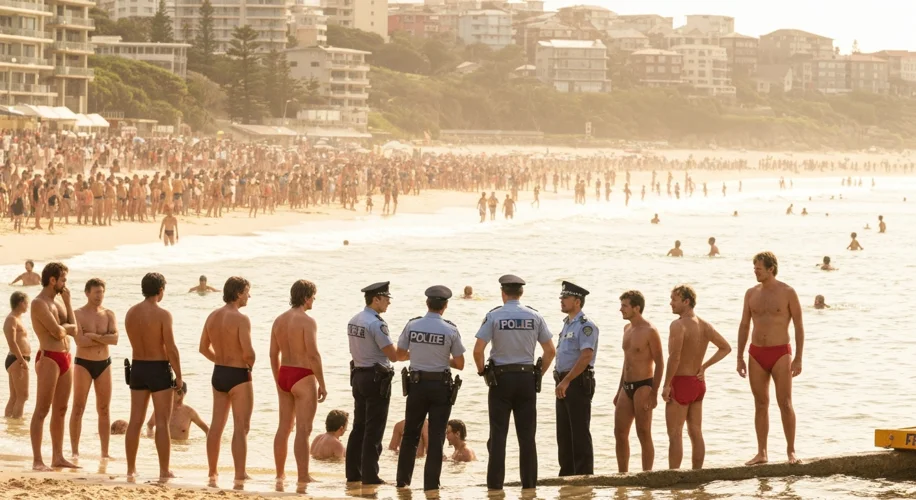
The confrontation eventually led to a number of arrests, and the images of police grappling with beachgoers on the iconic sands of Bondi were captured and broadcast, sending ripples far beyond the shores of Sydney.
The consequences of the Bondi Beach Incident were significant and far-reaching. In the immediate aftermath, the event sparked a fierce public debate across Australia. It became a potent symbol of the generational and cultural divides that marked the 1970s. For some, the police response was seen as an overreach of authority, a heavy-handed suppression of individual liberty and a naturalistic lifestyle. They argued that the police should have focused on actual crimes, not on what they considered a harmless act of personal freedom. For others, the incident validated their concerns about declining public morals and the need for law enforcement to uphold traditional standards of decency. They saw the police action as necessary to protect the beach environment from what they perceived as offensive behaviour.
This debate extended into the legal and political realms. The arrests led to court cases, and the incident became a touchstone in discussions about public indecency laws and freedom of expression. It brought the issue of nudism and public nudity into mainstream conversation, forcing communities to confront their attitudes and the often-blurry lines between personal freedom and public order. While it didn’t lead to an immediate decriminalization of nudism in public spaces, it certainly contributed to a broader reassessment of social norms and the role of law enforcement in policing personal behavior.
Furthermore, the Bondi Beach Incident highlighted the complex relationship between popular culture, media representation, and public perception. The visual nature of the event, captured by photographers and news crews, amplified its impact and cemented its place in the Australian consciousness. It became more than just a local disturbance; it was a narrative played out on a global stage, reinforcing Bondi’s image as a place of both beauty and occasional upheaval.
In retrospect, the Bondi Beach Incident of 1974 serves as a compelling case study in social change and the dynamics of cultural conflict. It was a moment when the carefree spirit of a summer beach day collided with the rigidities of law and the evolving, often contentious, landscape of social mores. The event forced a nation to look at itself, at its values, and at the ever-present tension between individual liberty and the collective good. The echoes of that sun-drenched, chaotic day on Bondi continue to resonate, reminding us that even in the most idyllic settings, the currents of social change can stir up unexpected storms.