
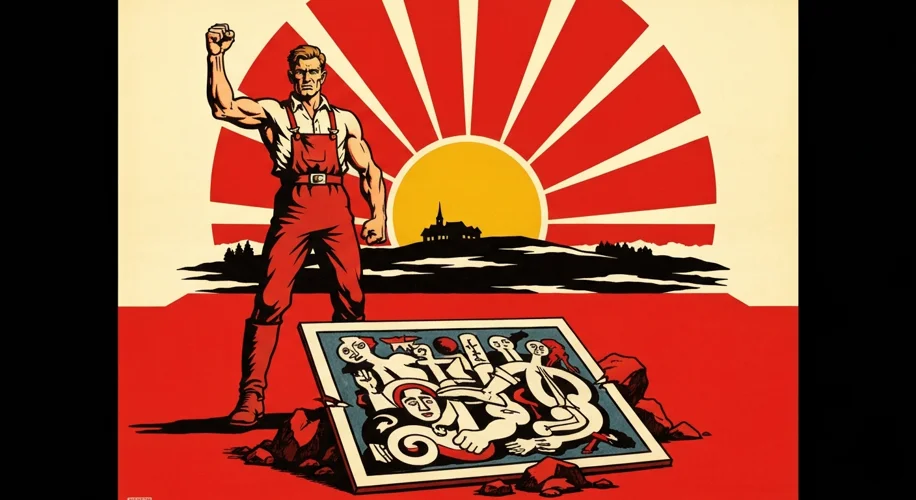
In the chilling aftermath of 1933, as the swastika unfurled across Germany, a new, insidious apparatus began to tighten its grip on the nation’s soul. This was not a weapon of war, but a weapon of the mind: the Reich Chamber of Culture (Reichskulturkammer). Spearheaded by the Reich Minister of Propaganda, Joseph Goebbels, this organization became the ultimate arbiter of what Germans could see, hear, read, and experience in the realm of arts and culture. Its aim was stark and terrifying: to purge and control, ensuring every facet of cultural life adhered to the rigid, warped ideology of the Nazi regime.
Imagine a Germany ablaze with creative fervor, a nation that had once birthed Bach, Beethoven, Goethe, and Schiller. Now, a suffocating blanket of ideological conformity was being systematically draped over this rich heritage. Goebbels, a master manipulator and a fervent believer in the power of propaganda, understood that controlling culture was as vital as controlling the press or the military. If the Nazis could shape the artistic expression of a nation, they could shape its very thoughts and beliefs.
Established in September 1933, mere months after Hitler’s ascent to power, the Reich Chamber of Culture was not a suggestion; it was a mandate. Membership was not optional for anyone wishing to earn a living in the arts. Whether you were a painter, a musician, a writer, an actor, a sculptor, or even a bookseller, you had to be a member. And to be a member, you had to prove your ‘Aryan’ credentials and, more crucially, your ideological purity. This was the first, and often insurmountable, hurdle for many talented individuals who didn’t fit the Nazi mold.
The Chamber was structured into seven sub-chambers, each targeting a specific artistic domain:
- The Reich Music Chamber (Reichsmusikkammer): Led by the composer Richard Strauss initially, this chamber dictated what music was permissible. Works by Jewish composers like Felix Mendelssohn and Gustav Mahler were banned. Modernist, atonal, or ‘degenerate’ music was outlawed, and composers were encouraged to produce works that glorified the German nation, its folk traditions, and its military might.
- The Reich Theatre Chamber (Reichstheaterkammer): Playwrights and actors were scrutinized. Plays deemed subversive, decadent, or anti-national were removed from repertoires. The emphasis shifted to heroic dramas, historical epics glorifying Germany, and comedies that reinforced traditional social norms.
- The Reich Film Chamber (Reichsfilmkammer): Film was a powerful medium, and Goebbels used it extensively for propaganda. This chamber controlled every aspect of filmmaking, from script approval to distribution. Glorious epics like ‘Kolberg’ were made, alongside virulently antisemitic propaganda films like ‘The Eternal Jew’.
- The Reich Press Chamber (ReichspresseKammer): While technically under the Ministry of Propaganda, its cultural impact was immense. Journalists and editors had to be members, ensuring news and opinion aligned with Nazi doctrine.
- The Reich Chamber of Literature (Reichsschrifttumskammer): Writers faced strict censorship. Books deemed ‘un-German’ were purged from libraries and bookstores. The works of banned authors, including many Nobel laureates, were relegated to bonfires.
- The Reich Chamber of Visual Arts (Reichskammer der Bildenden Künste): Artists were expected to produce work that celebrated the ‘Aryan ideal,’ rural life, military heroism, and the strength of the German Volk. Abstract art, impressionism, and any form of modernism were condemned as ‘degenerate art’ (Entartete Kunst).
- The Reich Chamber of Music (Reichsmusikkammer): This covered music, but also extended to composers, performers, and music educators.
This wasn’t just about banning books or silencing composers; it was a systematic attempt to re-engineer German culture itself. The regime actively promoted what it deemed ‘healthy’ art – art that was representational, easily understood, and ideologically sound. Think of romantic landscapes, heroic portraits, and scenes of idealized rural life. Anything that challenged, questioned, or expressed the anxieties and complexities of modern life was deemed a threat.
The consequences were devastating. Thousands of artists, writers, musicians, and intellectuals – many of them Germany’s most brilliant minds – were silenced, exiled, or worse. Albert Einstein, Thomas Mann, Bertolt Brecht, Arnold Schoenberg, Marc Chagall, and countless others were forced to flee. Their contributions were lost to Germany for years, a gaping wound in its cultural fabric.
Furthermore, this control extended beyond mere exclusion. The Nazis organized exhibitions of ‘degenerate art’ to mock and revile it, turning what should have been celebrated into a spectacle of scorn. The infamous exhibition of ‘Entartete Kunst’ in Munich in 1937 was a prime example, showcasing distorted and ‘offensive’ works to a bewildered and often repulsed public, carefully curated to reinforce Nazi propaganda.
The Reich Chamber of Culture was a chilling testament to how a totalitarian regime can weaponize creativity. It demonstrates the fragility of artistic freedom and the profound importance of protecting diverse voices. By controlling the narrative through art, Goebbels and the Nazis sought to build a ‘culture’ that mirrored their hateful ideology, a sterile, obedient imitation of true artistic expression. The echoes of this cultural purge continue to serve as a somber reminder of the dangers of unchecked state power over the human spirit.