
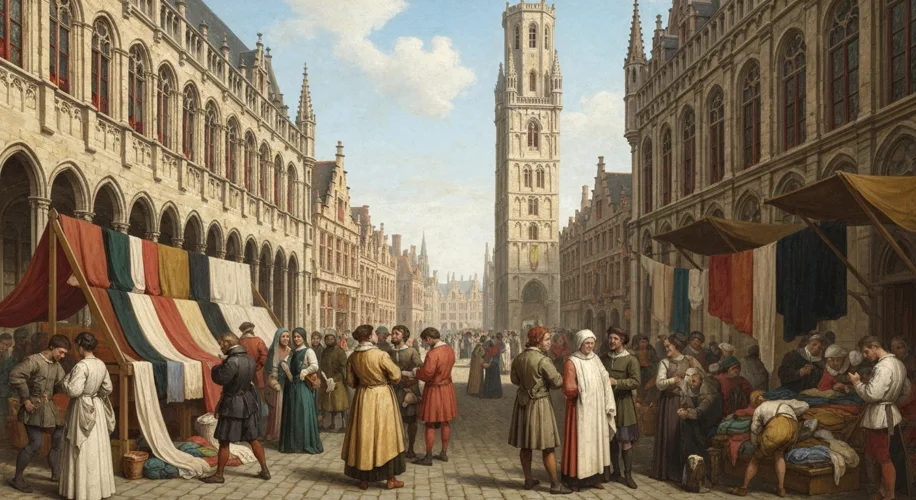
Imagine a city humming with an energy rarely seen. Not the frenetic rush of modern metropolises, but a deep, resonant thrum born of industry, wealth, and the relentless pursuit of quality. This was Ypres in the High Middle Ages, a Flemish jewel whose heart beat to the rhythm of wool.
From the 11th century onwards, Ypres began its ascent, transforming from a modest settlement into a powerhouse of European commerce. Its secret weapon? The humble sheep, or rather, the exquisite cloth woven from their fleece. The wool wasn’t just any wool; it was renowned for its softness, durability, and vibrant dyes, attracting merchants from across the continent. This wasn’t merely a trade; it was an art form, a meticulously crafted product that fueled Ypres’s identity and prosperity.
The city’s landscape was indelibly shaped by this booming industry. Towering cloth halls, like the magnificent Stadhuis (Town Hall) and the Belfry, stood as proud testaments to the wealth generated by the wool trade. These weren’t just administrative buildings; they were the nerve centers of a complex economic ecosystem. Within their walls, merchants haggled, quality was assessed, and fortunes were made and lost. The Belfry, with its imposing presence, served as a constant reminder of the city’s autonomy and the power vested in its guilds.
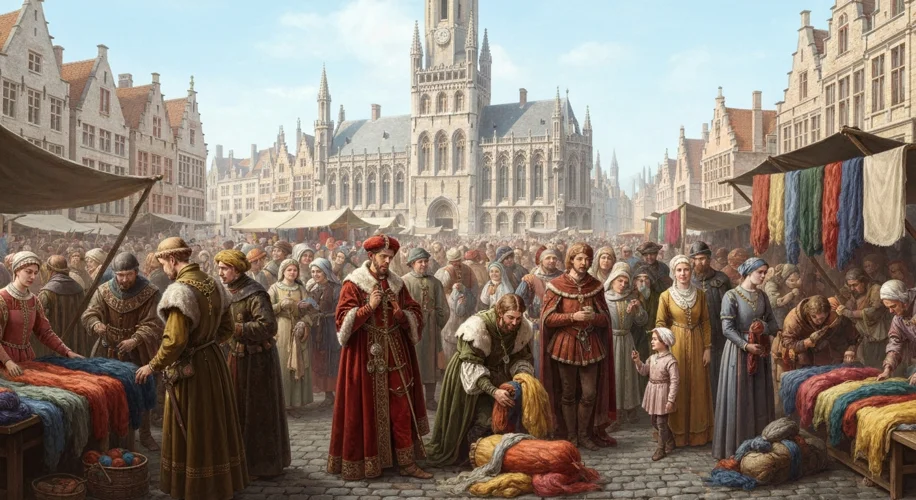
The social fabric of Ypres was tightly woven with threads of class and occupation, all centered around the cloth trade. At the apex were the wealthy merchant guilds, the ‘Lords of the Cloth,’ who controlled production, set standards, and wielded significant political influence. Their power was so immense that they often dictated terms to the city’s rulers. Below them were the skilled artisans – the weavers, dyers, and fullers – whose expertise was vital to the industry’s success. Their lives, though less opulent than the merchants’, were often comfortable, supported by the consistent demand for their craft. However, a vast underclass of unskilled laborers, often migrant workers, formed the base of this economic pyramid. They toiled in the less desirable, more physically demanding aspects of cloth production, their lives precarious and dependent on the ebb and flow of trade.
The sheer scale of the industry meant that daily life in Ypres was intrinsically linked to wool. The air would have carried the distinct, earthy smell of raw wool and the sharp, sometimes pungent, aromas of the dyes. The soundscape would have been a constant symphony of clacking looms, the rhythmic thud of fulling hammers, and the animated chatter of merchants and customers in the bustling market squares. Even the clothing worn by the citizens, from the simplest peasant to the wealthiest burgher, would have been a direct product of this industry, a visible display of social standing and the city’s primary economic output.
But beneath this veneer of industrious prosperity, the concentration of wealth and power, and the sheer density of people living and working in close proximity, created fertile ground for more clandestine activities. The constant flow of goods and people through Ypres, coupled with the anonymity offered by the crowded urban environment, could have facilitated illicit dealings. Smuggling of raw wool or finished cloth to avoid taxes, secret meetings between rival merchant factions, or even more shadowy enterprises could have thrived in the dimly lit alleys and bustling docks. The very systems designed to regulate the trade – the weighing stations, the guild rules – could have been circumvented by those with enough cunning and connections.
By the 14th century, Ypres was one of the largest cities in Europe, its population reaching an estimated 40,000 to 50,000 inhabitants, a testament to the cloth trade’s success. However, this golden age was not to last. External factors like war, economic downturns, and the rise of competing textile centers in England and Italy began to chip away at Ypres’s dominance. Yet, the legacy of its woolen heart endured, shaping its urban development, its social structure, and its place in the grand tapestry of medieval European history.
Ypres serves as a powerful reminder of how a single industry can utterly transform a city, creating not just economic wealth, but a unique way of life, a complex social hierarchy, and even, perhaps, a hidden world of intrigue lurking just beneath the surface of its thriving commerce.