The year is 1493. The ink is barely dry on Christopher Columbus’s logbook, and tales of a ‘New World’ are already electrifying the courts of Europe. But as ships set sail with dreams of glory and riches, a far more potent force was at play, one wielded not with cannons or cutlasses, but with the solemn authority of the Vatican: the Papal Bull.
Imagine the scene: the grand halls of the Apostolic Palace in Rome, the air thick with incense and the weight of centuries of spiritual power. Here, the Pope, the Vicar of Christ on Earth, would issue decrees that could shape the destinies of nations and the very geography of the known world. These weren’t mere suggestions; they were official pronouncements, carved in the weighty language of canon law, carrying the full spiritual and temporal weight of the Holy See.
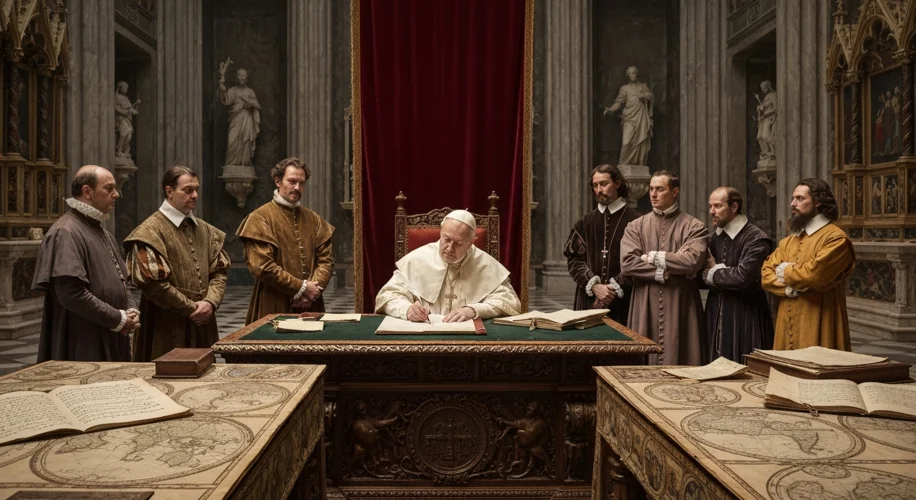
In the nascent years of the Age of Exploration, the Pope’s word was not just law; it was divine mandate. European monarchs, eager to claim new territories and spread Christianity, often sought papal endorsement for their ambitious ventures. This is where the Papal Bulls, particularly those concerning the discovery and division of lands beyond Europe, became crucial diplomatic and legal instruments.
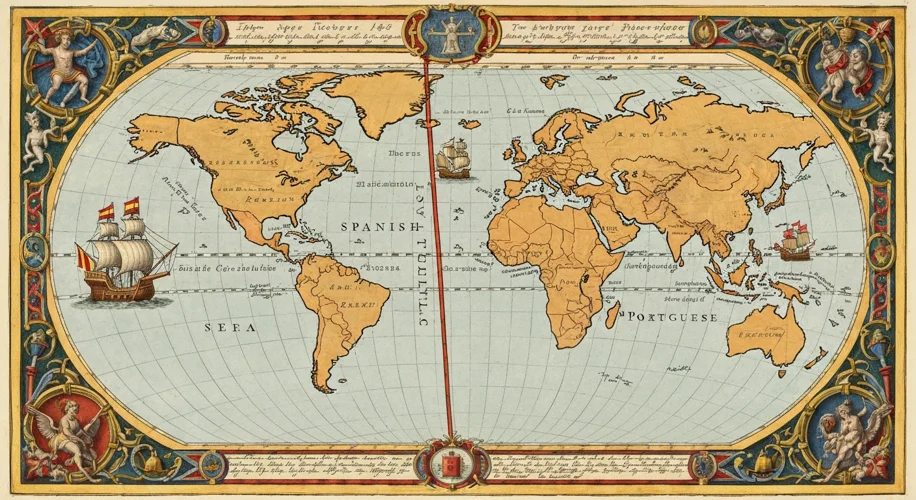
One of the most significant of these was the Inter caetera, issued by Pope Alexander VI in 1493. This bull, following Columbus’s groundbreaking voyage, aimed to settle territorial disputes between Spain and Portugal, the two leading maritime powers of the time. The world, as they knew it, was expanding at an unprecedented rate, and the potential for conflict was immense. The Pope, as a neutral arbiter and spiritual leader, stepped in to prevent a holy war of discovery.
The Inter caetera drew an imaginary line, a meridian running north to south, 100 leagues west of the Azores and Cape Verde Islands. This line, the Pope decreed, would divide the newly discovered lands. All lands to the west of this line were granted to Spain, and all lands to the east were granted to Portugal. It was a bold stroke, carving up the unknown with a few strokes of a quill, and it was heavily influenced by an earlier papal bull, Romanus Pontifex of 1455, which had granted Portugal rights over newly discovered lands in Africa.
The implications of these bulls were profound. They not only legitimized the claims of European powers but also provided a framework for colonization, exploitation, and the evangelization of indigenous populations. The bulls framed these actions within a religious context, presenting them as a divine mission to bring Christianity to heathen lands. This provided a powerful moral and legal justification for conquest, often overshadowing the rights and existence of the people already living in these territories.
However, the strict adherence to these lines proved difficult. The Treaty of Tordesillas, signed in 1494 between Spain and Portugal, effectively moved this dividing line further west to 370 leagues west of the Cape Verde Islands. This renegotiation, driven by practical considerations and the realization that the original line was impractical and potentially disadvantageous to Portugal, highlights the complex interplay between papal authority and secular power. While the Pope had drawn the initial map, it was the monarchs who ultimately redrew it to suit their own ambitions.
These papal pronouncements were more than just territorial grants; they were expressions of a worldview deeply intertwined with religion and a nascent understanding of global geography. They reflect the ambitions, anxieties, and the profound sense of divine right that characterized the European powers of the era. The bulls, in essence, were the legal and spiritual scaffolding upon which the edifice of European colonial empires was built. They laid the groundwork for centuries of exploration, conquest, and the reshaping of the global political landscape, leaving an indelible mark on the history of continents and cultures alike.
So, the next time you look at a map, remember that its lines are not just geographical features, but echoes of decrees penned centuries ago by the stroke of a papal quill, forever dividing and shaping the world we inhabit.