
The year is 1494. Europe, a continent simmering with ambition and discovery, stands on the precipice of a world-altering decision. Across the Atlantic, whispers of new lands, of untold riches, and of vast, uncharted territories have reached the ears of kings and queens. But with discovery comes conflict, and the burgeoning empires of Spain and Portugal, both fueled by the Pope’s blessing and an insatiable hunger for expansion, find themselves staring down the barrel of a territorial dispute.
Imagine the scene: the opulent halls of Tordesillas, Spain, where diplomats, weary from weeks of negotiation, gathered. The air crackled not with the clash of steel, but with the tension of competing claims. At the heart of their deliberations was a simple, yet profoundly impactful, concept: a line. An imaginary line drawn across the globe, a cosmic red pen wielded by European powers to carve up the known and unknown world.
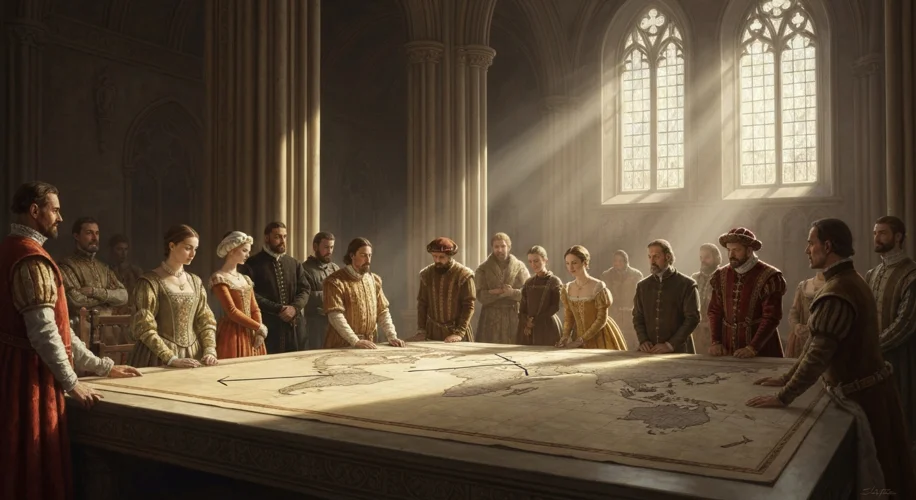
This wasn’t just any line; it was the Line of Demarcation, established by the Treaty of Tordesillas. Its purpose was stark: to divide the newly discovered lands outside Europe between Portugal and Spain. Lands west of the line belonged to Spain; lands east, to Portugal. It was a bold assertion of papal authority and a pragmatic, albeit ethnocentric, attempt to avoid escalating conflict between the two Iberian superpowers.
The Age of Discovery and the Papal Decree
To understand the gravity of this line, we must rewind slightly. The late 15th century was an era of unparalleled maritime exploration. Portugal, under the visionary Prince Henry the Navigator, had been diligently charting the coast of Africa, seeking a sea route to the lucrative spice markets of Asia. Spain, spurred by Christopher Columbus’s audacious (and ultimately misguided) westward voyage in 1492, had stumbled upon the Americas, a continent previously unknown to Europeans.
With these monumental discoveries came the inevitable question: who owned what? Both nations were devoutly Catholic, and in a move that underscored the era’s intertwined nature of religion and politics, Pope Alexander VI issued a papal bull, Inter caetera, in 1493. This bull essentially granted Spain dominion over all lands west of a meridian 100 leagues west of the Azores and Cape Verde Islands. However, Portugal, a key papal ally, felt this line was too far to their west, unfairly limiting their potential gains, especially in the Atlantic.
The Portuguese Gambit and the Treaty of Tordesillas
King John II of Portugal was not one to cede ground easily. He initiated direct negotiations with Ferdinand and Isabella of Spain, bypassing the Pope’s initial decree. The result was the Treaty of Tordesillas, signed on June 7, 1494. The key alteration? The line was moved westward to 370 leagues west of the Cape Verde Islands. This seemingly small adjustment had colossal consequences.
Why was this move so significant? Because it placed the easternmost bulge of South America, unknowingly within Portuguese sphere of influence, allowing Portugal to claim Brazil. Had the line remained as dictated by the papal bull, Brazil, and potentially vast swathes of South America, would have been Spanish territory. The treaty effectively divided the world into two colonial spheres, dictating the linguistic, cultural, and political destinies of entire continents for centuries to come.
The Players and Their Stakes
On one side stood Portugal, a seasoned maritime power eager to solidify its dominance over the Atlantic and the East Indies trade. On the other, Spain, a rising power suddenly thrust onto the global stage by Columbus’s discoveries, eager to capitalize on its newfound territories in the ‘New World’. The Pope, Alexander VI, initially played a crucial role, but ultimately, the practicalities of geopolitical power and negotiation between the two kingdoms shaped the final outcome.
From their perspective, this was a matter of survival and prosperity. For Portugal, it was about securing its established trade routes and ensuring access to the riches of the East. For Spain, it was about legitimizing its claim to the vast lands across the Atlantic and preventing future conflict with its Iberian rival. The indigenous populations of these newly claimed lands, of course, were entirely absent from these discussions, their fates sealed by a line drawn on a map by foreign powers.
The Unseen Continent and the Unseen Line
The irony of the Line of Tordesillas is that it was drawn without a complete understanding of the world’s geography. The negotiators had no accurate maps of the Pacific Ocean, and the exact longitude of the line was a matter of intense debate and imprecise measurement for centuries. The consequences were profound:
- Brazil and Portuguese America: The eastward shift of the line directly led to Portugal’s claim over Brazil. This single consequence shaped the cultural and linguistic landscape of South America, making Brazil a Portuguese-speaking island in a predominantly Spanish-speaking continent.
- Spanish Dominance in the Americas: Spain secured the lion’s share of the Americas, leading to its vast colonial empire stretching from North to South America, influencing its languages, religions, and legal systems.
- Limited European Colonialism Elsewhere: While the treaty primarily focused on the ‘New World’, its principles were extended, albeit with less clarity, to other regions. However, it did little to prevent other European powers like England, France, and the Netherlands from eventually challenging Iberian dominance.
- Seeds of Future Conflict: The inherent imprecision of the line and the eventual encroachment of other European powers meant that the Tordesillas division was never absolute and often led to further disputes and conflicts.
A Legacy Etched in History
The Treaty of Tordesillas, born from a desire to partition the world, ultimately laid the groundwork for the colonial empires of Spain and Portugal. It stands as a testament to the era’s Eurocentric worldview, where vast continents and their inhabitants were treated as commodities to be divided by decree. The line itself may have faded into the annals of history, but its shadow is cast long, shaping the very fabric of nations, cultures, and languages we see today. It is a powerful reminder that sometimes, the most impactful boundaries are not made of stone or steel, but of ink on parchment and the ambition of kings.
It serves as a critical chapter in understanding the global power dynamics that emerged from the Age of Discovery, a time when an imaginary line drawn in a Spanish town irrevocably altered the course of human history.