
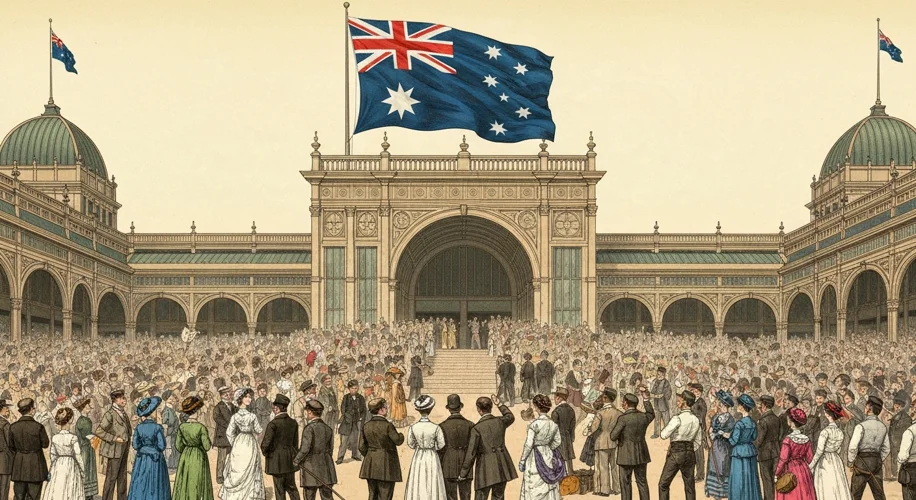
The year is 1901. Australia, a young nation forged from six self-governing colonies, stands on the precipice of federation. A new identity is needed, a symbol to unite a vast continent. The call goes out: design a flag that speaks of Australia. What unfolded was a contest that captured the nation’s imagination, a competition that would ultimately weave together a symbol of unity, heritage, and aspiration, even as it retained a clear nod to the old world.
Before Federation in 1901, the colonies of Australia flew various flags, often incorporating the Union Jack to signify their British heritage, but also adding local symbols. The idea of a national flag was born out of the growing sense of distinct Australian identity, fueled by a shared history, a unique landscape, and a developing sense of self-determination.
On April 29, 1901, the Prime Minister of Australia, Edmund Barton, announced a nationwide competition to design a new federal flag. The prize: a modest sum of £40, and the immense honor of creating a symbol for the nascent nation. The response was overwhelming. Over 32,000 entries flooded in, a testament to the public’s engagement with this pivotal moment in Australian history. Designers, amateur and professional alike, from every walk of life, put pen to paper, their imaginations soaring with visions of Australia.
The design brief was clear: the flag should represent the federation, the common ties of the United Kingdom, and distinctive Australian characteristics. Critically, it was to be a flag that could be recognized from a distance, making its symbolic elements paramount.
The sheer volume of submissions meant a rigorous selection process. A panel of judges, including Barton himself, was tasked with sifting through the creative outpouring. Many designs were deemed too complex, others too derivative. The judges were looking for a balance of tradition and innovation, a flag that was both familiar and uniquely Australian.
Ultimately, the winning design wasn’t a single stroke of genius from one individual, but a collaborative effort. The judges decided to combine elements from several strong entries. The most significant of these were the designs submitted by five individuals: E.J. Bisset, a former naval officer; J.A. Vaughan, a government clerk; W.J. Daverne, an architect; and two schoolboys, Arthur Louis Anthony Dorse and Ivan Long.
The dominant feature of the winning design was, and remains, the Union Jack in the canton (the upper hoist corner). This was a deliberate and significant choice. It symbolized Australia’s historical ties to the British Empire, a connection that was deeply ingrained in the nation’s legal, political, and social fabric at the time. It spoke of shared heritage, a common language, and allegiance to the Crown. 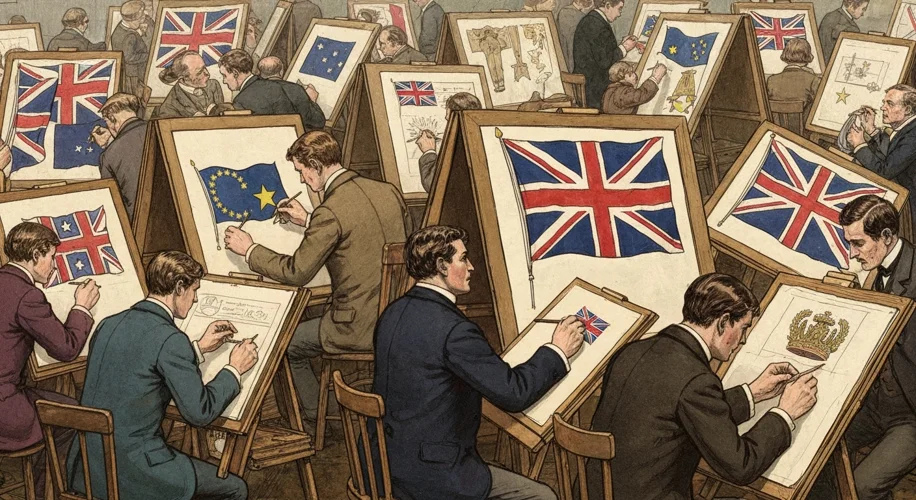
Beneath the Union Jack, a large seven-pointed star was placed. This was the Commonwealth Star, symbolizing the six federated states and any future territories that might join the Commonwealth. Its seven points represented the original six states, with the seventh point added to acknowledge the Northern Territory and Papua New Guinea (which would later become a protectorate). This star was a powerful emblem of unity and the burgeoning federal structure.
Dominating the fly (the outer part of the flag) was the constellation of the Southern Cross. Depicted as five white stars on a blue background, this celestial grouping is a prominent feature of the Southern Hemisphere’s night sky and has long been associated with Australia. The stars were arranged to mirror their actual positions, a touch of astronomical accuracy that lent authenticity to the design.
While the inclusion of the Union Jack was a concession to tradition and imperial ties, it was not without its detractors. As Australia grew and sought to assert its own identity on the world stage, the Union Jack’s presence would become a point of debate. However, in 1901, it was a symbol that resonated with the majority of the population, signifying Australia’s place within the vast and powerful British Empire.
The new flag was officially flown for the first time on September 3, 1901, at the Royal Exhibition Building in Melbourne, the temporary seat of the federal government. This date is now commemorated annually as Australian National Flag Day. The design was officially gazetted in 1903, and in 1908, the distinctive red ensign (the Australian Red Ensign) with the Union Jack and Commonwealth Star was designated as the official flag of the Australian merchant marine, while the blue ensign was adopted for naval and government use. The Royal Proclamation of 1934 declared the blue ensign the ‘Australian National Flag.’
The adoption of the Australian flag in 1901 was more than just the choosing of a national symbol; it was an act of nation-building. It acknowledged Australia’s past while looking firmly towards its future. The flag, with its stars and the enduring presence of the Union Jack, became a potent emblem of a nation finding its voice, a visual narrative of its journey from colonial dependence to independent nationhood, forever marked by the Southern Cross in the vast southern sky.