The year is 1966. The People’s Republic of China, still in its relative infancy, was about to be plunged into a decade of unprecedented social and political upheaval. This was the dawn of the Great Proletarian Cultural Revolution, a movement initiated by Mao Zedong, the very architect of the new China.
Mao, the Chairman, saw a growing threat. He believed that elements of capitalism and traditional Chinese culture were subtly, insidiously creeping back into the fabric of Chinese society, corrupting the purity of the communist ideology he had fought so hard to establish. He feared that the revolution, once a fiery force, was cooling into a more bourgeois and bureaucratic entity. His solution? A radical, violent purge, a call to action for the youth to rise up and cleanse the nation.
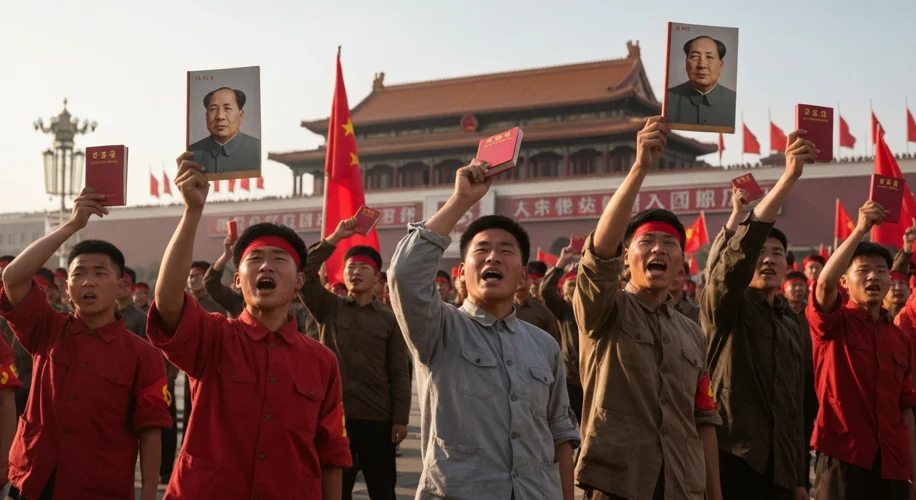
The Red Guards were born from this call. These were primarily students, teenagers and young adults, fueled by revolutionary fervor and Mao’s cult of personality. They saw themselves as the vanguards of the revolution, tasked with destroying the ‘Four Olds’: old ideas, old culture, old customs, and old habits. Their methods were brutal and often fanatical.
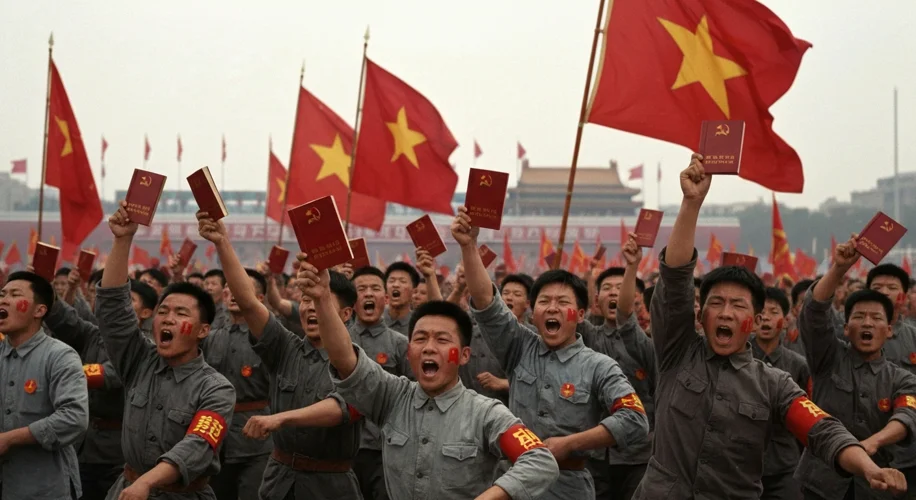
Imagine the scene: vast rallies in Tiananmen Square, the air thick with slogans and the rhythmic chanting of Chairman Mao’s Little Red Book. Young people, their eyes burning with conviction, denounced their teachers, their parents, anyone deemed an ‘enemy of the revolution.’ Intellectuals, artists, and perceived ‘class enemies’ were publicly humiliated, paraded through the streets in dunce caps, their homes ransacked, their possessions confiscated. Countless individuals were beaten, tortured, imprisoned, or sent to labor camps in the countryside to be ‘re-educated’ through hard toil.
The Cultural Revolution was not a single, monolithic event, but a series of tumultuous phases. Initially, Mao encouraged the Red Guards to challenge the existing party structure, leading to widespread chaos and infighting among factions. By 1968, realizing the movement had spiraled out of his control, Mao called upon the People’s Liberation Army to restore order, often suppressing the very Red Guards he had unleashed. The subsequent ‘Down to the Countryside Movement’ saw millions of urban youth forcibly relocated to rural areas, ostensibly to learn from the peasants but in reality, to remove them from the political landscape and to provide labor.
The human cost was staggering. While exact figures are impossible to ascertain, estimates suggest that millions perished as a direct result of the violence, persecution, and hardship. Countless others suffered lifelong trauma. The destruction of cultural heritage was immense. Ancient temples, artworks, books, and historical sites were defaced or destroyed, seen as symbols of a feudal past that needed to be eradicated. Universities were shut down, scientific research was halted, and intellectual life was stifled, setting China back decades in terms of development.
The Cultural Revolution officially ended with Mao’s death in 1976. The subsequent rise of Deng Xiaoping marked a turning point, with the Communist Party eventually denouncing the movement as a catastrophic mistake. Yet, the echoes of this tumultuous decade continue to reverberate through Chinese society. It left a deep scar on the nation’s collective memory, a period of trauma and disillusionment that shaped a generation and continues to influence China’s political and social landscape today.
The Cultural Revolution remains a complex and painful chapter in Chinese history. It serves as a stark reminder of the dangers of unchecked ideological fervor, the cult of personality, and the devastating consequences that can arise when a nation turns upon itself in the name of revolution.